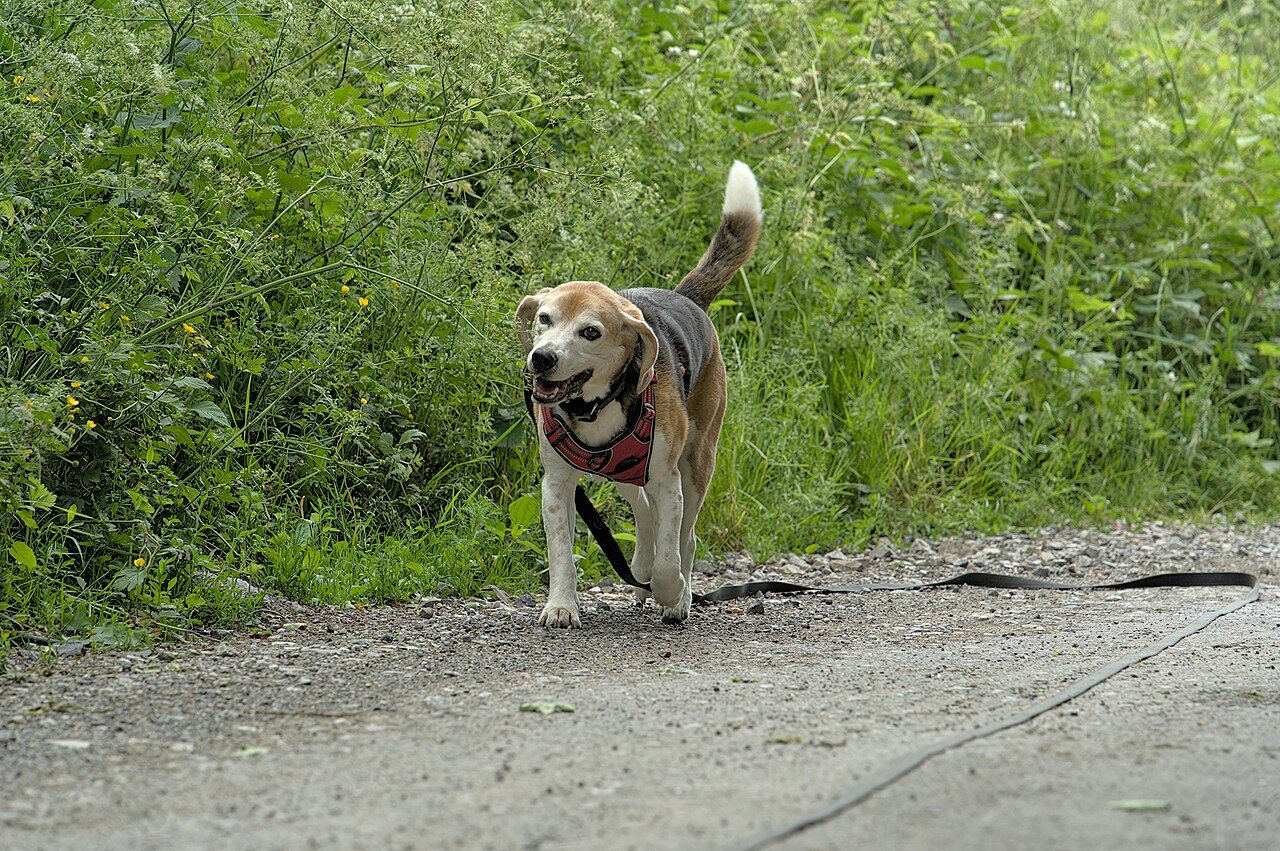
Every year, millions of dogs slip a leash, bolt through an open gate, or follow an interesting smell straight out of the neighborhood. A microchip only helps if someone finds your dog and scans it. A GPS tracker tells you where your dog is right now — and the difference between those two things is the difference between a scary afternoon and a lost dog.
How dog GPS trackers actually work
There are three fundamentally different technologies sold as "dog trackers," and buying the wrong type for your situation is the most common disappointment. Cellular trackers use the same mobile networks as phones: the tracker gets its position from GPS satellites, then sends that position to an app on your phone over LTE. Range is effectively unlimited — your dog could be three states away and you'd still see it — but coverage dies wherever cell service dies, and they require a monthly or annual subscription, typically $8–15 per month.
Bluetooth trackers are the small tags popularized for keys and wallets. They don't have GPS at all; they just broadcast a Bluetooth signal your phone can detect within roughly 100–300 feet, and they piggyback on other people's phones to report a rough last-seen location. No subscription, cheap, tiny — and nearly useless for a dog that's actually running. They're fine for "which room of the house is the cat in" but not for a lost dog.
Radio trackers use dedicated radio frequencies with a handheld receiver, the kind hunters have used for decades. No subscription, no cell network needed, and they work deep in the backcountry. The trade-offs: the receiver is a separate device you must carry and learn, range is typically a few miles, and the good systems cost several hundred dollars. For off-leash hiking and hunting dogs in areas without cell coverage, radio is still king.
The subscription question
Almost every true GPS tracker for dogs requires a subscription, and this is where sticker shock happens. The device might cost $35–50, which feels reasonable — then the app demands $9.99/month or $99/year before it will show you a single location. There is no way around this: real-time position updates over cellular networks cost the manufacturer money on every ping, and they pass it to you.
Do the math over the device's life, not just day one. A $40 tracker at $10/month costs $160 in year one and $120 every year after. That is still cheap compared to the cost — financial and emotional — of a lost dog, but compare total cost of ownership when shopping, not just the hardware price. Annual plans usually cut 20–30% off the monthly rate. Some trackers also offer a "lost dog mode" that increases location update frequency at the cost of battery; check whether that mode costs extra or is included.
One more subscription trap: a few trackers lock basic features like location history or geofence alerts behind higher tiers. Before buying, confirm that live tracking, escape alerts, and at least a day of location history are in the base plan.
What to look for before you buy
Accuracy is the headline spec, and honest numbers matter more than marketing. Consumer GPS is typically accurate to about 10–30 feet in open sky — enough to find a dog in a field, not enough to tell which side of a fence it's on. In dense woods, urban canyons, or heavy cloud cover, accuracy degrades. No collar tracker will give you turn-by-turn precision; expect "the dog is in this yard," not "the dog is behind the shed."
Battery life is the spec that determines whether you'll actually keep using it. Most cellular trackers last 2–10 days depending on update frequency and how often the dog moves (a moving tracker pings more). If charging a dog's collar every two days sounds like a chore you'll abandon by month two, you're right — look for models advertising a week or more, and be honest with yourself about the charging habit. Low-battery alerts to your phone are essential, not optional.
Size and weight matter enormously for small dogs. A tracker that's a comfortable pendant on a lab is a boat anchor on a chihuahua. As a rough rule, the tracker plus mount should stay under 5% of the dog's body weight, and the mount should sit flat against the collar rather than dangling. Dangling trackers snag on brush and crates.
Waterproofing should be genuine, not "splash resistant." Dogs swim, roll in mud, and stand in rain. Look for an IP67 rating or better, which means surviving full submersion. And check the mount: the best tracker in the world is useless if its collar clip pops off the first time the dog scratches. Twist-lock or screw mounts beat friction clips.
Escape alerts and virtual fences
The single most valuable feature isn't the map — it's the escape alert. You draw a virtual fence around your home in the app, and the moment the tracker crosses it, your phone buzzes. This is what turns a tracker from a recovery tool into a prevention tool: you know the gate was left open within seconds, not when you notice the silence.
Two things to verify: alert speed and false alarms. Good systems alert within a minute or two of a boundary crossing. Cheaper ones can lag 10+ minutes, by which time a fast dog is a mile away. False alarms happen near boundary edges due to GPS drift — set your virtual fence slightly inside your actual property line so normal yard wandering doesn't trigger panic alerts you'll start ignoring.
Some trackers also log activity — distance walked, rest time, calories. Treat this as a bonus, not a buying criterion. The step-counter accuracy on pet trackers is rough, and you're buying location safety, not a fitness coach.
Matching the tracker to the dog
The escape artist — the husky that scales fences, the terrier that digs under them — needs fast escape alerts, a secure mount that survives squeezing through gaps, and a long battery life, because you may not notice it's gone for an hour. Prioritize alert speed and mount security over fancy app features.
The hiking companion — off-leash on trails, ranging ahead — needs accuracy in tree cover and battery that survives a full day of movement. If you hike where cell service drops, a cellular tracker will go dark exactly when you need it most; that's the one scenario where a radio system or a tracker with offline position logging earns its price.
The city dog — leashed walks, dog parks, the occasional slipped collar — does fine with a basic cellular tracker. Range is unlimited, coverage is excellent in cities, and the main job is answering "which direction did it go" in the first panicked minutes.
The tiny dog — under 15 pounds — needs the smallest, lightest tracker you can find, full stop. A heavy tracker changes how a small dog moves and can rub the neck raw. This is the one category where I'd accept shorter battery life in exchange for less weight.
What GPS trackers can't do
A tracker is not a substitute for training, a secure fence, or a leash. It won't stop a dog from running into traffic — it just tells you where the traffic incident happened. It won't work if the battery is dead, if the dog slipped the collar (a depressingly common failure mode — the tracker stays home on the collar while the dog leaves), or if you're somewhere with no cell coverage on a cellular model.
Consider pairing the tracker with a martingale collar or a harness the dog can't back out of, so the tracker actually stays on the dog. And keep the microchip and ID tags current regardless — the tracker is your first line of defense, not your only one.
Frequently asked questions
Do dog GPS trackers work without a subscription?
True real-time GPS trackers need a subscription for the cellular data that carries location updates. Bluetooth tags work without one but only show nearby or last-seen locations — they can't track a running dog. Radio systems have no subscription but need a separate handheld receiver.
How accurate are dog GPS trackers?
Typically within 10–30 feet in open sky. Trees, buildings, and heavy cloud cover reduce accuracy. It's enough to find a dog in a neighborhood or field, not enough to pinpoint which bush it's behind.
Will a tracker work if my dog goes somewhere without cell service?
Cellular trackers go dark without cell coverage — they can't send their position to your phone. Some store positions and upload them when back in range. For true off-grid tracking, radio-frequency systems are the reliable choice.
Can the tracker fall off?
Yes, and it's the most common real-world failure. Twist-lock or screw mounts hold far better than clips. Pair the tracker with a collar or harness the dog can't slip, and check the mount weekly for wear.