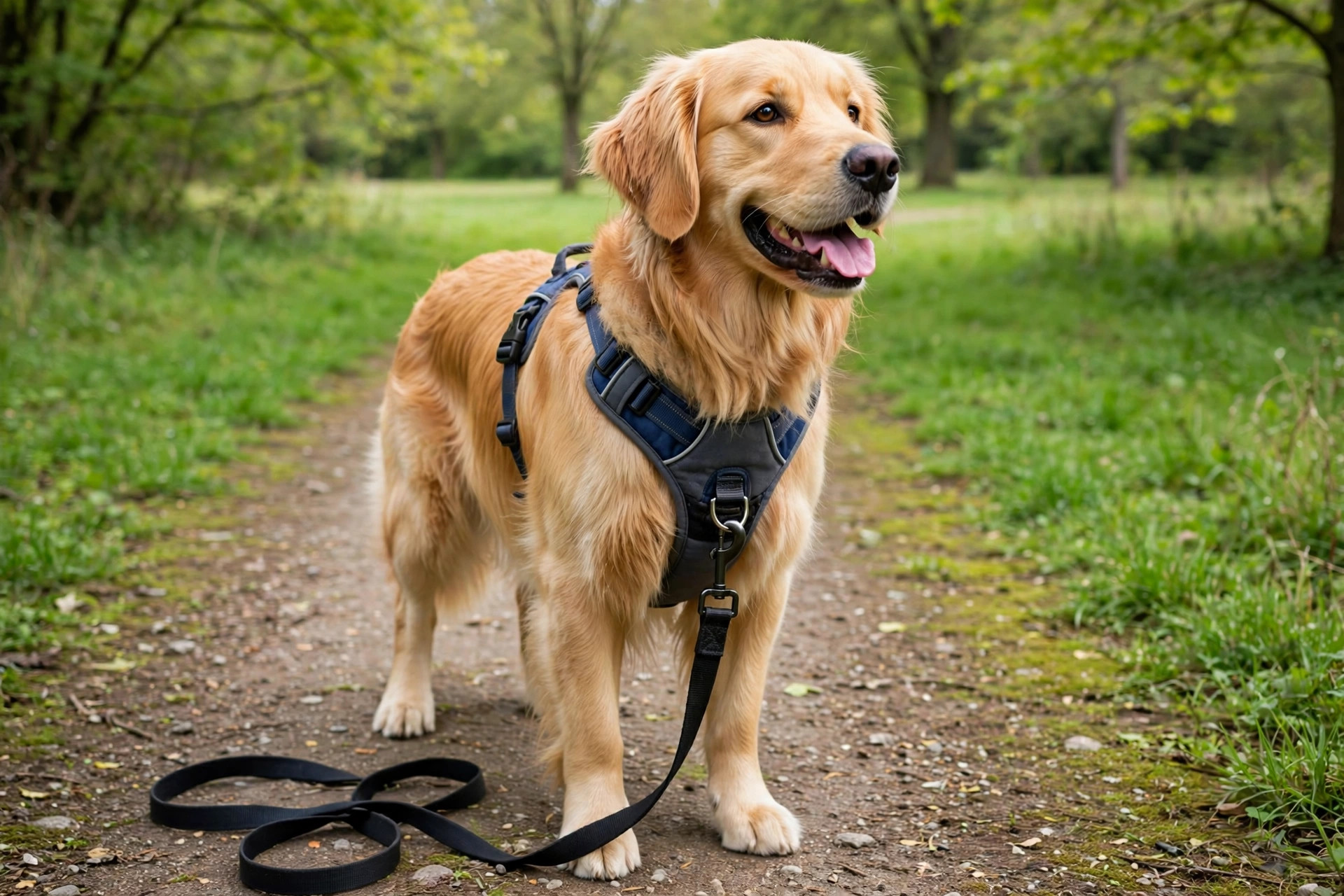
Every dog owner knows the walk: the first squirrel, the interesting smell across the street, and suddenly you're waterskiing behind 70 pounds of enthusiasm. A no-pull harness doesn't train your dog — but it changes the physics of pulling so walks become manageable while the training catches up. The front leash attachment redirects forward momentum sideways instead of letting your dog lean into it like a sled dog, which is why a $30 harness often outperforms months of half-hearted leash corrections. This guide covers how no-pull harnesses work, how to fit one, the best picks for every size of puller, and the training that makes the harness a bridge rather than a crutch.
How no-pull harnesses actually work
A standard back-clip harness is, biomechanically, a pulling harness — it's what sled dogs wear, and it lets your dog put their full weight into the leash comfortably. A no-pull harness moves the leash attachment to the front of the chest. When the dog lunges forward, the front attachment turns their shoulders sideways, redirecting the momentum instead of rewarding it. Pulling stops paying off, and most dogs figure that out within a few walks.
The honest framing matters: the harness manages the symptom, it doesn't teach loose-leash walking by itself. Think of it as training wheels — it makes walks pleasant now so you can actually practice the training (rewarding slack leash, stopping when the leash tightens) instead of dreading every outing. Dogs trained with a no-pull harness plus consistent reinforcement generally transition to a regular harness or collar faster than dogs whose owners just endure the pulling. For the broader harness-vs-collar question, see our harness vs. collar guide.
One caution: front-clip harnesses can restrict shoulder movement if poorly fitted or sized wrong, and some designs chafe behind the front legs. Fit matters enormously — more on that below — and no-pull harnesses are a management tool, not a substitute for addressing reactivity or fear with a trainer.
Front-clip vs. dual-clip vs. head halters
Front-clip harnesses have the leash ring on the chest strap. They're the simplest no-pull design, the most widely available, and the right starting point for most pullers. The tradeoff: the leash hangs under the dog's chest and can tangle in their legs, especially on small dogs.
Dual-clip harnesses have rings on both chest and back, used with a double-ended leash (one clip front, one clip back). This gives the most steering control — it's what many professional trainers use — and the back clip works as a regular harness once the dog learns. More hardware, slightly more fiddly, best control.
Head halters (not covered as picks here) loop around the muzzle and work like a horse halter — where the head goes, the body follows. Extremely effective for strong dogs, but many dogs hate the face pressure and need careful conditioning. Worth discussing with a trainer for serious pullers, but not a casual purchase.
Avoid: "no-pull" harnesses that work by tightening around the dog's torso or digging into the armpits when they pull. Aversive pressure designs can cause pain, chafing, and anxiety — the goal is redirection, not punishment.
Fitting: the step most people skip
A badly fitted no-pull harness is worse than none — it chafes, rotates, and teaches the dog that gear is miserable. Measure your dog's chest at the widest point (right behind the front legs) and neck, then follow the manufacturer's size chart — sizes vary wildly between brands, and "medium" means nothing across companies.
The fit checks: you should be able to slide two fingers under every strap — snug, not tight. The chest strap should sit across the breastbone, not up in the armpits (armpit straps chafe raw within a single long walk). The front ring should center on the chest. Watch the dog walk: if the harness rotates sideways, it's too loose; if the dog's gait changes or they start bunny-hopping, something's binding. Check the fit monthly — dogs' weight and coat thickness change with seasons, and a harness that fit in July may be wrong in January.
The picks: best no-pull dog harnesses
We compared specs across the harnesses owners actually buy — clip placement, adjustment points, padding, escape resistance, and size range. Prices move; check current listings.
Best overall: padded front-clip harness
A padded front-clip no-pull dog harness is the right default for most dogs: chest leash ring for steering, four or more adjustment points for a dialed fit, and padding on the chest and belly straps to prevent chafing. Look for a sturdy metal D-ring (not plastic) on the chest and reflective trim for evening walks. Usually $25–$45, which is the category's sweet spot.
- Pros: front-clip steering genuinely reduces pulling for most dogs within a few walks
- Pros: padding plus multiple adjustment points means comfort across body shapes
- Cons: the leash can tangle under the chest on small or very active dogs
- Cons: determined pullers may still pull — it's management, not magic
Best for strong pullers: dual-clip harness with handle
A dual-clip no-pull harness for large dogs adds a back ring and a grab handle to the front-clip design. Used with a double-ended leash (front + back clips), it gives the most control short of a head halter — and the handle is genuinely useful for steadying a big dog past triggers like other dogs or squirrels. The right call for 60+ pound enthusiastic pullers. Usually $35–$60.
- Pros: maximum steering control; the handle is a real-world lifesaver with big dogs
- Pros: doubles as a regular back-clip harness once the dog learns loose-leash walking
- Cons: more straps and hardware — takes longer to put on and fit correctly
- Cons: needs a double-ended leash for the full effect, which is a separate purchase
Best budget: simple front-clip harness
A budget no-pull dog harness in the $15–$25 range covers the core mechanism — chest ring, basic straps, functional buckles — without the padding and refinement of premium models. Fine for mild pullers and for testing whether the front-clip concept works for your dog before investing more. Check reviews for strap quality at this price; the chest ring and buckles are the failure points.
- Pros: the cheapest way to test whether front-clip steering works for your dog
- Pros: simple design means easy on/off and easy washing
- Cons: minimal padding — watch for chafing on long walks or bare-coated breeds
- Cons: fewer adjustment points make a truly dialed fit harder
Best for small dogs: lightweight vest-style harness
A vest-style no-pull harness for small dogs distributes pressure across the chest instead of concentrating it on thin straps — important for little dogs with delicate tracheas and narrow chests. Look for step-in designs (no over-the-head wrestling with a head-shy small dog) and a front ring that doesn't drag on the ground. Usually $20–$35.
- Pros: vest design spreads pressure safely on small, fragile frames
- Pros: step-in styles avoid the over-the-head battle with nervous small dogs
- Cons: less steering leverage than strap harnesses — physics favors bigger designs
- Cons: vest styles run warmer, which matters for small dogs in summer
Best escape-proof: three-strap no-pull harness
An escape-proof no-pull harness adds a third belly strap behind the ribcage, which stops the classic back-out-and-bolt maneuver that Houdini dogs perform with standard two-strap harnesses. Essential for newly adopted dogs, sighthounds, and any dog with a narrower head than neck. Usually $30–$50; the extra strap adds security, not restriction, when fitted right.
- Pros: the third strap genuinely prevents backing out — the main escape route
- Pros: still a comfortable walking harness, not a restraint device
- Cons: one more strap to adjust and one more buckle in the morning routine
- Cons: the belly strap can collect burrs and debris on trail walks
The training that makes the harness work
The harness buys you manageable walks; training buys you a dog that doesn't need the harness. The core drill is simple: the moment the leash goes tight, you stop. The moment there's slack, you move and reward. Dogs learn fast that pulling turns the walk off and slack turns it on — but only if you're consistent, which is exactly what the harness makes possible by keeping walks pleasant enough to practice on.
Layer in the extras: reward check-ins (the dog voluntarily looking at you gets a treat), practice direction changes before the dog hits the end of the leash, and keep early sessions short — fifteen focused minutes beats an hour of rehearsed pulling. If your dog is reactive (barking, lunging at triggers) rather than just enthusiastic, that's a different problem worth a certified trainer's help; no harness fixes fear.
Timeline honesty: most owners see a dramatic same-week improvement from the harness alone, and genuine loose-leash walking — the kind that holds on a flat collar — typically takes 4–12 weeks of consistent practice. The harness is the bridge. Walk across it.
Our verdict
For most dogs, a padded front-clip harness in the $25–$45 range is the right buy — it's the simplest design that actually changes the pulling physics, and the padding plus adjustment points keep it comfortable enough for daily use. Big, powerful pullers deserve the dual-clip with handle; escape artists need the three-strap. Whatever you choose, measure twice, fit carefully, and pair it with the stop-and-go training above — the harness makes walks manageable today, and the training makes the harness optional tomorrow.
Frequently asked questions
Will a no-pull harness stop my dog from pulling completely?
It significantly reduces pulling for most dogs by redirecting momentum, but it's a management tool, not training. Pair it with consistent loose-leash practice — stopping when the leash tightens, rewarding slack — for lasting results.
Are front-clip harnesses bad for a dog's shoulders?
A well-fitted front-clip harness used for normal walks is considered safe by most trainers and vets. Problems arise from poor fit — straps sitting in the armpits or restricting leg movement. Check the fit regularly and watch your dog's gait.
Can puppies use no-pull harnesses?
Yes, with a lightweight, well-fitted model — and it's actually a great time to start, since you're building habits rather than fixing them. Keep sessions short and positive; for very young puppies, prioritize socialization and basic leash comfort over any equipment.
Harness or collar for a dog that pulls?
A harness, almost always — collars concentrate pulling force on the trachea, which risks injury in enthusiastic pullers. Our harness vs. collar guide covers the full comparison, including when a collar is fine.
How do I stop the leash from tangling under my dog's chest?
It's the main annoyance of front-clip designs. A slightly shorter leash helps, as does a dual-clip harness with a double-ended leash, which keeps one attachment on the back. Some owners also use a leash with a swivel clip to reduce twisting.