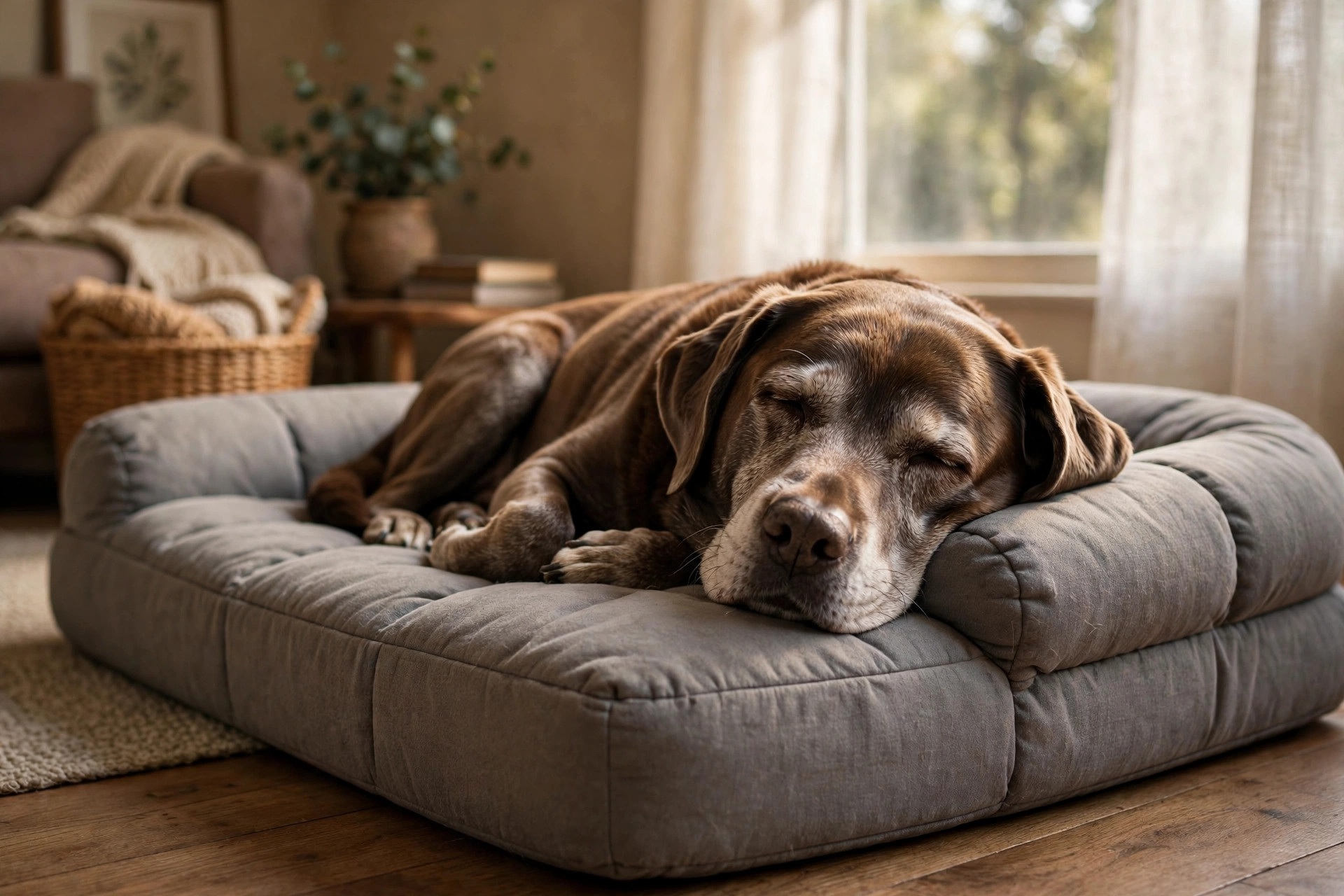
Watch a senior dog get up in the morning and you can see the math of aging in every stiff step. Arthritis, hip dysplasia, and plain old worn-out joints make hard floors punishing — and a thin bargain bed that bottoms out under 80 pounds is barely better than the floor itself. A real orthopedic bed uses dense memory foam thick enough to keep joints off the ground, distribute weight evenly, and cushion the pressure points that ache most. For a senior dog, it's not a luxury purchase; it's the highest-impact comfort upgrade you can buy. This guide covers what makes a bed genuinely orthopedic, how to size one, and the best picks for aging dogs.
What "orthopedic" actually means in a dog bed
The word is unregulated — any manufacturer can print "orthopedic" on a pillow stuffed with shredded foam. A genuinely orthopedic bed has three things: high-density memory foam (not egg-crate convoluted foam, not fiberfill, not shredded scraps) that conforms to the dog's body and springs back; enough thickness that a heavy dog can't compress it to the floor — 4 inches minimum for large breeds, 6–7 for giants; and support that lasts, meaning foam that doesn't develop a permanent crater after six months.
Why it matters for seniors: arthritic joints hurt most at pressure points — elbows, hips, shoulders — where bone presses against a hard surface. Memory foam spreads the dog's weight across the whole body surface, cutting peak pressure dramatically. Dogs with better beds measurably move more easily in the mornings, sleep more deeply (which aids recovery), and are more willing to lie down and rest instead of pacing. It's one of the few interventions where owners consistently report a visible difference within days.
The honest limit: a bed manages comfort, it doesn't treat disease. If your senior is newly stiff, reluctant on stairs, or slow to rise, that's a vet conversation about pain management — the bed is the support act, not the treatment. (And if your dog destroys beds rather than sleeping on them, our chew-proof beds guide is the one you want — this guide is about joint support, not durability against teeth.)
Sizing: measure the dog, not the room
The #1 sizing mistake is buying for the space instead of the sleeper. Measure your dog in their favorite sleeping position — nose to tail base for curlers, nose to extended paws for sprawlers — and add 6–8 inches. A bed that's too small forces joints off the edge (defeating the purpose); a bed that's comically oversized is just wasted money and floor space.
Weight rating matters as much as dimensions. A bed marketed for "large dogs" with 3 inches of low-density foam will bottom out under a 90-pound lab — check the foam thickness and density specs, not just the size label. For dogs over 100 pounds, look for 6+ inches of foam or specifically marketed giant-breed models.
Bolsters — the raised edges — deserve a thought. Many seniors love resting their head on a bolster (it eases neck strain), but dogs with limited mobility can find high bolsters hard to climb over. Low bolsters or a flat mattress style suit the stiffest seniors best.
What to look for in an orthopedic dog bed
Solid memory foam slab, 4+ inches. One continuous piece of high-density memory foam, not layered scraps. Press it: quality foam resists and rebounds slowly; cheap foam collapses and stays dented.
Washable, waterproof-lined cover. Senior dogs have accidents — it's not a question of if. A removable machine-washable cover with a waterproof inner liner protects the foam, because memory foam that gets soaked is ruined. This feature is close to mandatory for seniors.
Non-slip bottom. A bed that slides across hardwood when a stiff dog tries to stand on it is a fall hazard. Rubberized or textured bottoms keep the bed planted during the wobbly stand-up.
Certified foam. Look for CertiPUR-US certification on the foam — it means no ozone depleters, no heavy metals, low VOCs. Your dog breathes inches from this surface for 14 hours a day; the certification is worth caring about.
The picks: best orthopedic dog beds for senior dogs
We compared specs across the beds senior-dog owners actually buy — foam type and thickness, cover washability, size range, and value. Prices move; check current listings.
Best overall: thick memory-foam orthopedic bed
A thick memory-foam orthopedic dog bed is the right default: a solid 4-inch (or thicker) high-density memory foam slab, removable washable cover with waterproof liner, and sizes from medium through XL. This is the configuration that delivers the actual joint-support benefit — everything else in the category is a variation on it. Usually $60–$120 depending on size, which is the value sweet spot for real foam.
- Pros: solid high-density foam that won't bottom out under heavy seniors
- Pros: waterproof liner plus washable cover handles the realities of senior life
- Cons: genuinely good foam is heavy — moving an XL bed for washing day is a workout
- Cons: flat mattress style offers no headrest for dogs that love a bolster
Best for large and giant breeds: XL 7-inch foam bed
An XL orthopedic dog bed for large dogs with 6–7 inches of foam is what giant breeds actually need — a 110-pound senior will compress a standard 4-inch bed to the floor, which means zero joint benefit. Look for specifically giant-rated models with reinforced covers, because the fabric takes a beating at this scale. Usually $100–$180; expensive, but it's the only tier that works for the biggest dogs.
- Pros: foam thick enough that even giant breeds can't bottom it out
- Pros: properly scaled dimensions fit sprawling large-breed sleep positions
- Cons: the priciest tier, and the bed dominates a room
- Cons: very heavy — plan on it living where you put it
Best with bolsters: orthopedic sofa-style bed
An orthopedic dog bed with bolsters combines the memory-foam base with raised sides for head-resting — the sofa style most dogs gravitate toward. The key spec: the sleeping surface itself must still be genuine thick memory foam, not a thin pad inside a plush frame. Best for seniors that are stiff but still mobile enough to step over a low bolster. Usually $70–$140.
- Pros: bolsters give arthritic necks a comfortable headrest — many seniors strongly prefer them
- Pros: the "walls" create a den-like feel that anxious seniors find calming
- Cons: bolsters are an obstacle for the stiffest dogs — watch whether yours struggles to climb in
- Cons: more seams and crevices to clean than a flat mattress style
Best cooling: gel-infused orthopedic bed
A cooling orthopedic dog bed adds gel-infused memory foam or a breathable cooling cover to the standard orthopedic build — meaningful for seniors, who often run warm and struggle to regulate temperature, especially in summer or warm climates. The cooling effect is modest but real: gel foam dissipates heat better than standard memory foam, which is notorious for sleeping hot. Usually $80–$150.
- Pros: addresses the legitimate complaint that memory foam sleeps hot
- Pros: same joint-support foam density as the best overall pick
- Cons: "cooling" is relative — it's cooler than standard foam, not air-conditioned
- Cons: gel models tend to be firmer, which some dogs take a few nights to accept
Best budget: egg-crate orthopedic bed
A budget egg-crate orthopedic dog bed in the $30–$55 range uses convoluted ("egg-crate") foam rather than solid memory foam. It's honest about what it is: better than a flat pad or the floor, not as supportive as true high-density memory foam. Reasonable for medium-size seniors without severe arthritis, or as a second bed for another room. Check thickness — under 3 inches of egg-crate is barely orthopedic at all.
- Pros: the cheapest real step up from a basic pad — genuine improvement for mild stiffness
- Pros: lightweight and easy to move between rooms
- Cons: egg-crate foam compresses faster and supports less than solid memory foam
- Cons: not enough for heavy dogs or advanced arthritis — size and severity matter
Helping a senior accept the new bed
Some seniors claim a new bed instantly; others eye it suspiciously for a week. Place it where the dog already sleeps — location familiarity beats bed novelty. Put a worn t-shirt or their old blanket on top for the first few days so it smells like home, and reward every voluntary interaction with the bed: sniff it, treat; step on it, treat; lie down, jackpot. Never force or lure-and-trap a nervous senior onto it.
For dogs with significant mobility issues, consider the bed's surroundings too: a non-slip rug path to the bed, a ramp if it's slightly elevated, and nighttime lighting for dogs with fading vision. The bed is one piece of a senior-comfort setup — warmth (older dogs chill easily), easy water access, and traction on slick floors round it out.
Maintenance: wash the cover on the schedule the label suggests (monthly is a good baseline for seniors), air the foam in sunlight occasionally, and replace the bed when the foam stops rebounding — press the center, and if the dent lingers, the support is gone. Even good foam has a lifespan of 2–4 years under a heavy daily sleeper.
Our verdict
For most senior dogs, a thick solid-memory-foam bed with a waterproof liner and washable cover is the right buy — it's the configuration that actually delivers joint support, and the waterproofing handles senior realities. Giant breeds need the XL 6–7 inch tier; there's no way around the physics. Warm sleepers get the gel-cooling model, and head-resters get the bolster sofa style. Whatever you choose, size to the dog's sleeping position, verify the foam is genuinely thick and dense, and pair the bed with a vet conversation if stiffness is new or worsening — comfort gear and pain management work best together.
Frequently asked questions
How thick should an orthopedic dog bed be?
Four inches of high-density memory foam is the minimum for genuine joint support in medium and large dogs; giant breeds need 6–7 inches. If you can press the foam and feel the floor through it, it's not thick or dense enough.
What's the difference between memory foam and egg-crate foam?
Solid memory foam is a continuous dense slab that distributes weight evenly and rebounds slowly. Egg-crate (convoluted) foam has peaks and valleys — it's softer, cheaper, better ventilated, but less supportive and it compresses permanently faster. For arthritic seniors, solid memory foam is meaningfully better.
My senior dog won't use the new bed. What do I do?
Put it where they already sleep, add a familiar-smelling blanket, and reward voluntary approaches — never force it. Give it a full week. If they still avoid it, the issue may be the height (bolsters too tall), the firmness, or the location rather than the bed itself.
How often should I replace an orthopedic dog bed?
When the foam stops rebounding — press the center and watch. Quality memory foam lasts 2–4 years under daily use by a heavy dog. A permanent crater means the joint support is gone even if the cover still looks fine.
Are elevated cot-style beds good for arthritic dogs?
Usually not ideal for seniors with significant stiffness — climbing onto a cot and the hammock-style sag can both be hard on arthritic joints. Ground-level memory foam is the safer default for seniors; cots suit younger dogs and hot climates better.